
What to Track in Your Life-in-Weeks Grid (If You Want to Ship)
April 7, 2026
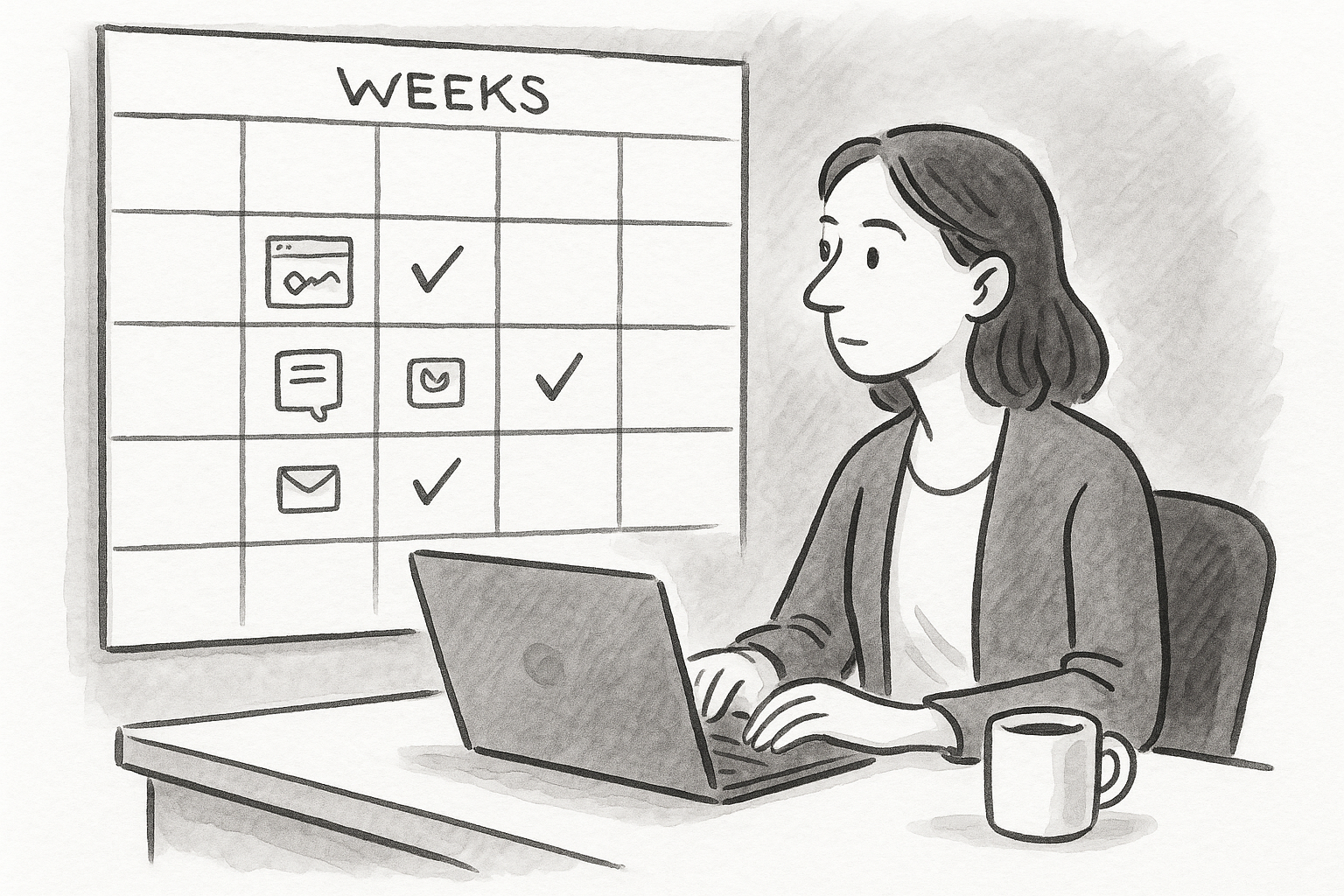
Your Life-in-Weeks grid should track shipped outcomes, not habits or hours. Color only what customers notice: deployed features, live pages, revenue actions, customer conversations with notes, completed experiments, and executed decisions.
Your Life-in-Weeks grid should not track habits, hours, or "stayed busy." As a founder, color only shipped outcomes. Things a customer could notice, or decisions you executed that changed your plan.
It's like an accountability coach for your week.
A week is a unit of execution. Drift kills weeks.
The rule: Color only what a customer or market could notice
A Life-in-Weeks grid has about 4,680 squares. If your squares represent "effort," you will fill them fast and still end the year asking, "What did I actually ship?"
Here is the only rule that keeps the grid honest.
The "Shipped" definition
A week is Shipped if at least one of these is true:
- Released: deployed to production, published, sent, launched
- Live: a landing page, checkout change, email sequence, pricing change, ad, or partnership went live
- Revenue touched: you invoiced, charged, closed, saved a renewal, or advanced a deal
- Customer truth captured: conversations happened, notes logged, next action chosen
- Experiment completed: hypothesis defined and result recorded
- Decision executed: you killed a project, cut scope, chose a niche, or changed your roadmap
If it did not reach a user, a customer, or your calendar in a way you cannot "undo," it does not get colored.
Outcome marker vs task marker
Every marker should be externally verifiable or irreversible.
- Outcome marker: "Landing page live + 50 visits tracked"
- Task marker: "Worked on landing page"
- Outcome marker: "Feature deployed to production and available to users"
- Task marker: "Did some coding"
- Outcome marker: "5 customer calls completed. Notes logged. Next actions chosen"
- Task marker: "Did outreach"
FocusNinja is built around this same standard. Log wins. The coach uses wins as evidence. The system does not reward motion. It rewards shipped proof.
The only week markers worth coloring
These are the categories that compound. They create a visible "I ship weekly" identity without turning your grid into a habit sticker chart.
1) Shipped customer-facing value
This is product value a user can feel.
Counts:
- Feature deployed to production
- Bug fix shipped that reduces support load
- Onboarding improvement shipped
- Docs shipped that answer a top support question
Doesn't count:
- "Worked on a feature"
- Refactor, cleanup, backlog grooming
- More tickets closed
In FocusNinja, set your Weekly Intention as a specific shipment. Use the Focus Timer tied to that shipment, not random sessions. Log the win when it is deployed.
2) Shipped landing pages and offers
Founders drift when distribution stays "almost ready." Color the week when it is live and measurable.
Counts:
- Landing page published with tracking installed
- Offer page updated with new positioning and clear CTA
- Lead magnet shipped and connected to email capture
- Checkout page change shipped and monitored
Doesn't count:
- Wireframes
- "Drafted copy"
- "Reviewed competitors"
Anti-gaming rule: To color this, it must be live and you must have at least one measurement. Example: "LP live + 50 visits tracked" or "LP live + 3 leads captured."
In FocusNinja, Morning Anchor keeps you aligned to the one distribution asset that makes the week colorable. Midweek Pulse forces the question: "Is it going live by Sunday, yes or no?"
3) Revenue actions
Revenue is often lagging. Actions are leading. Track revenue actions that create or protect cash.
Counts:
- Invoice sent
- Payment collected
- Renewal saved
- Deal advanced to a clear stage
- Pricing change applied and revenue monitored
Doesn't count:
- "Checked Stripe"
- "Updated CRM"
- "Brainstormed pricing"
Color revenue actions, not revenue mood. Good: "Sent 10 invoices." Better: "Sent 10 invoices and 8 paid."
FocusNinja's Weekly Review gives you a verdict grounded in proof, not feelings.
4) Customer conversations (with notes and next action)
A call is worthless if it vanishes. Color the week only when the learning is captured and used.
Counts:
- Discovery calls completed
- Onboarding calls completed
- Churn interviews completed
- Support conversations that produced a product change
But only if: Notes are captured AND a next action is chosen.
Doesn't count:
- "Had some chats on Twitter"
- Calls with no notes
- Calls that did not change anything
In FocusNinja, log customer call wins as evidence. The Weekly Review turns messy notes into decisions and next steps.
5) Experiments run (hypothesis plus result logged)
Founders love "trying things." Most of it is unmeasured. Your grid should force the scientific method.
Counts:
- Messaging test run with defined hypothesis
- Channel test shipped with measurable outcome
- A/B test completed with recorded result
But only if: Hypothesis is written before you run it AND result is logged after.
Doesn't count:
- "Tested ads" with no hypothesis
- "Posted content" with no intent or measurement
In FocusNinja, Weekly Intention becomes "Run experiment X and log result Y." Weekly Review forces a verdict. If nothing shipped or nothing was learned, the week gets called out.
6) Decisions made (and executed)
This is the most founder-specific marker. Most people treat decisions as thoughts. You only color decisions that change your plan.
Counts:
- Killed a project and removed it from the roadmap
- Chose a niche and updated site copy
- Cut scope and shipped the smaller version
- Picked a KPI and changed your weekly plan to match
Doesn't count:
- "Thought about strategy"
- "Made a plan" that did not change the calendar
- "Wrote ideas"
Irreversible test: If someone looked at your calendar, roadmap, or product, would they see the decision?
In FocusNinja, you set who you are becoming, then prove it with executed decisions. Midweek Pulse catches drift before you waste the week debating.
What not to track (productivity theater)
These are psychologically rewarding and business-light. They make your grid colorful and your quarter empty.
The blacklist
Do not color squares for:
- Hours worked
- Deep work sessions
- Emails cleared
- Meetings attended
- GitHub commits
- Tasks closed
- Ideas captured
- Habit streaks
Vanity KPIs without an action loop
Do not color squares for:
- Impressions
- Followers
- Website visits (unless tied to a shipped distribution action)
The replacement rule
Track delivery, not effort. Effort can be faked. Delivery is proof.
This is the core FocusNinja stance: Busy isn't progress. Shipped is progress.
How to visualize shipped outcomes without confetti
Your grid must stay readable. If every week has five colors, you will start gaming.
Use 3 to 5 colors max
A simple founder legend that works:
| Color | Marker | What it proves |
|---|---|---|
| Green | Shipped customer value | Users got something new or better |
| Blue | Shipped distribution | The market saw a new asset or message |
| Gold | Revenue action | Cash was created or protected |
| Purple | Customer conversations | You collected customer truth and acted |
| Red | Experiment completed | You ran a test and logged a result |
If you want fewer: keep only Green, Blue, Gold.
Cap colors per week
Rules that keep you honest:
- You can earn multiple markers, but cap at 2 colors per week
- If you want to color a third, write the one sentence proof next to it
Keep blank weeks on purpose
A blank square is not shame fuel. It is drift data.
In FocusNinja, drift is the signal. Morning Anchor starts aligned. Midweek Pulse corrects drift. Weekly Review makes the week tell the truth.
The weekly loop: earn next week's square on purpose
If your grid does not change your calendar, it is just art. The point is to decide what will make next week colorable, then ship it.
Step 1: Pick one "definition of done" shipment
For next week, define one outcome that earns a color.
Good definitions:
- "Deploy onboarding fix that reduces signup drop-off"
- "Publish landing page and send it to 30 targeted prospects"
- "Run pricing experiment and log result by Sunday"
Bad definitions:
- "Work on onboarding"
- "Do marketing"
In FocusNinja, this is your Weekly Intention.
Step 2: Use Morning Anchor to start aligned
Each morning, state the one move that makes the week shippable. What matters today for the weekly shipment?
This prevents you from burning the day on urgent noise.
Step 3: Use Midweek Pulse to catch drift early
Midweek ask one brutal question: "If the week ended tonight, would I have proof worth coloring?"
If no, you change the plan on Wednesday, not Sunday night.
Step 4: Weekly Review
At the end of the week:
- Log the win that earned the color
- Write one sentence: what did you learn, decide, or change?
FocusNinja makes this concrete with a weekly verdict: Shipped / Wasted / Enjoyed. It is not moral judgment. It is feedback.
Real founder scenarios
You can still track shipped outcomes even when results lag.
If you are pre-launch
Color weeks for:
- "Waitlist page live and shared to 20 people"
- "Offer page live with a clear price and CTA"
- "10 customer calls completed. Notes logged. ICP updated"
Do not color weeks for:
- "Built in private" with nothing released
If you run a services business
Color weeks for:
- "Proposal sent"
- "Contract signed"
- "Invoice sent and paid"
- "Case study published"
If you have long feedback loops
Track shipped leading actions:
- "3 partner pitches sent and 1 meeting booked"
- "SEO page published and indexed"
- "Security questionnaire completed and sent"
Do not wait months to color a square. Color the week you shipped the action with proof.
Pick one thing. Track wins. Get a weekly verdict.
Start aligned in the morning. Correct drift midweek. Review on Sunday.
FocusNinja turns this into a system. Your North Star becomes a weekly intention. Your wins become evidence. Your weeks become a shipping habit.